Author

Ilian Azz
Founder
Computer science engineer, Sorbonne UTC graduate. Founder of kadrella.com, the platform built for private tutors.
Profile →Articles
 Pricing
Sibling discount: how much to cut without losing out
A sibling discount wins families with two or more children, but set wrong it eats your margin. The right rate, the invoice line, the traps to avoid.
Read the article → Taxes
CFE: how French private tutors can pay nothing
French private tutors can be exempt from the CFE business tax. The BOFiP conditions, the traps (premises, agencies) and how to contest a notice.
Read the article → Operations
Music teacher studio policy: a 6-point template
A studio policy sets the monthly fee, make-ups and holidays. A six-point template for music teachers plus the two French legal rules you must include.
Read the article → Invoicing
Late payment policy for tutors: the lever that works
With a private client, late-payment penalties and the €40 fee do not apply. A tutor’s real lever is when the payment is taken, written in a clear clause.
Read the article → Students
Preparing a student for the brevet: the 3-month plan
Since the 2026 session, 40% of the brevet rides on continuous assessment. A year-long calendar and a three-month revision plan for a 3e student.
Read the article → Growth
How to start a tutoring business in France in 4 steps
Register your activity, set a rate that holds, find your first students and get organised: the four steps to start a tutoring business in France legally.
Read the article →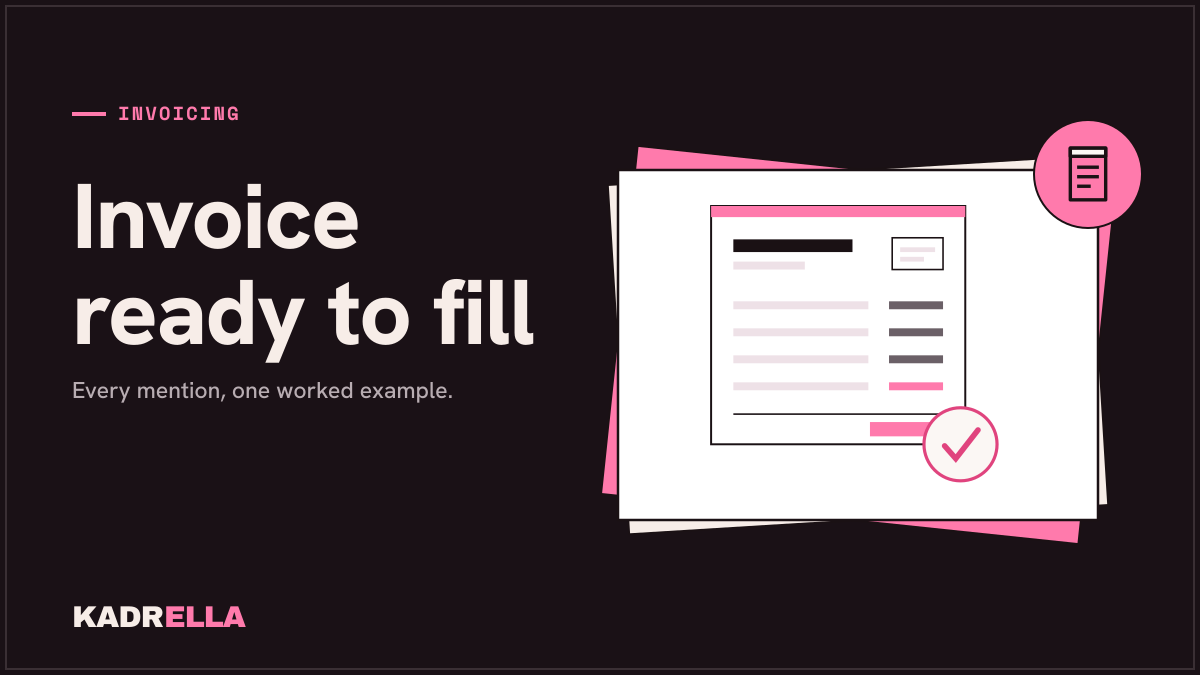 Invoicing
Tutoring invoice template: a filled example to copy
A ready-to-fill tutoring invoice for France: the mandatory mentions, a worked example, the VAT franchise line and the tax credit, laid out to copy.
Read the article →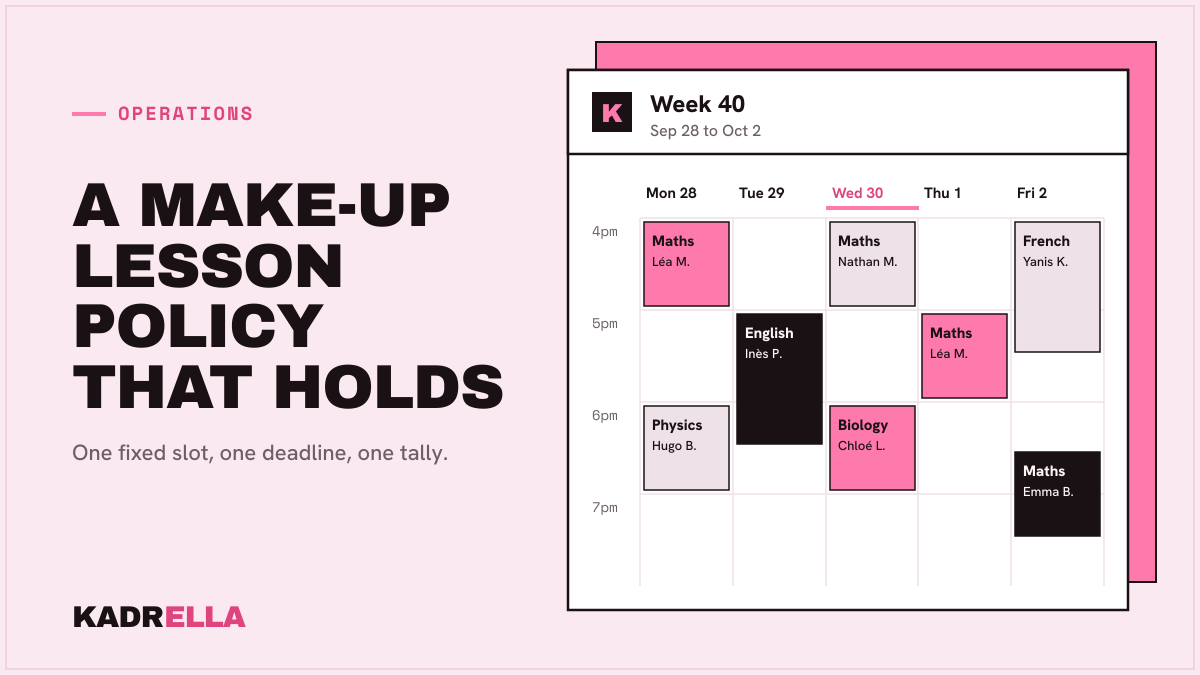 Operations
A tutoring make-up lesson policy that saves your week
Who earns a make-up lesson, how long it stays valid and which slot it goes in: a four-point policy that keeps cancellations from wrecking your week.
Read the article → Pricing
Private tutor net income in France: €20.50 out of €30
At €30 an hour, about €20.50 is left per hour after 25.6% contributions, income tax and costs. The full 2026 take-home calculation for a tutor in France.
Read the article → Students
Tutoring session notes for parents: 5-line template
Five-line session notes: what was covered, one win, one thing to review and the homework. A template, three examples by level and how often to send them.
Read the article → Growth
How to get tutoring clients with zero commission
Preply keeps up to 33% of each lesson. Referrals, a Google profile and local listings: how tutors find students directly without breaking platform rules.
Read the article → Invoicing
Unpaid tutoring invoice: recover it within 2 years
Dated reminders, a formal notice, a free conciliator, then an order for payment: how French tutors recover an unpaid tutoring bill before the 2-year limit.
Read the article → Taxes
Avance immédiate guarantee: often not required
With no deposits and under €200,000 a year, a tutor using the instant advance needs no financial guarantee. Who must file one, how much and how to send it.
Read the article → Taxes
Student tutors in France: which status pays less tax?
Student tutoring in France: Cesu employee or micro-entrepreneur? Income tax exemption, the €83,600 ceiling and the effect on your grant, compared.
Read the article → Pricing
Online vs in-home tutoring rates: price online fairly
At home, families get 50% back as a tax credit; online, they do not. Real costs of each format, typical rates and why online lessons should not be cheap.
Read the article → Pricing
Tutoring rates by level in France: €15 to €60 an hour
Primary €15 to €25, middle school €20 to €30, high school €25 to €40, prépa €35 to €60 an hour: tutoring rates by level in France and what pushes them up.
Read the article → Invoicing
Credit notes: fix a tutoring invoice the legal way
A sent invoice can no longer be edited. When to issue a corrective invoice or a credit note, what a credit note must show and common cases in tutoring.
Read the article → Taxes
Can public-school teachers tutor? Yes, with approval
A French public-school teacher can tutor privately with their employer’s approval. The cumul rules, the micro-entreprise status and the line not to cross.
Read the article → Taxes
ACRE for tutors: cut URSSAF fees, apply within 60 days
ACRE cuts a new tutor’s URSSAF contributions in year one, but the request must go in within 60 days. The 2026 rules, the July reform and how to apply.
Read the article → Invoicing
Home tutoring travel fees: stop giving away 96 hours
Four home lessons a week add up to about 96 hours of unpaid driving a year. Four ways to charge for travel, how to invoice it and what you can deduct.
Read the article → Growth
Superprof profile: 4 fixes that bring in leads
Photo, headline, rate and description: the four Superprof profile fixes that turn family searches into messages, plus a five-minute monthly check.
Read the article → Operations
Liability insurance for tutors: required? €90 to €200
Liability insurance is optional for most private tutors in France. What it covers, when an agency asks for it, and its usual cost of €90 to €200 a year.
Read the article → Taxes
Micro or real-expense regime: worth it above 35% costs
Micro-entreprise or real-expense EI? The real-expense regime pays off around 35% to 40% of real costs. The maths, what tutors can deduct, an example.
Read the article → Invoicing
E-invoicing in France: tutors are affected from 2026
From September 2026 every tutor must be able to receive e-invoices, and e-reporting follows in 2027. What really applies to tutors who bill families.
Read the article →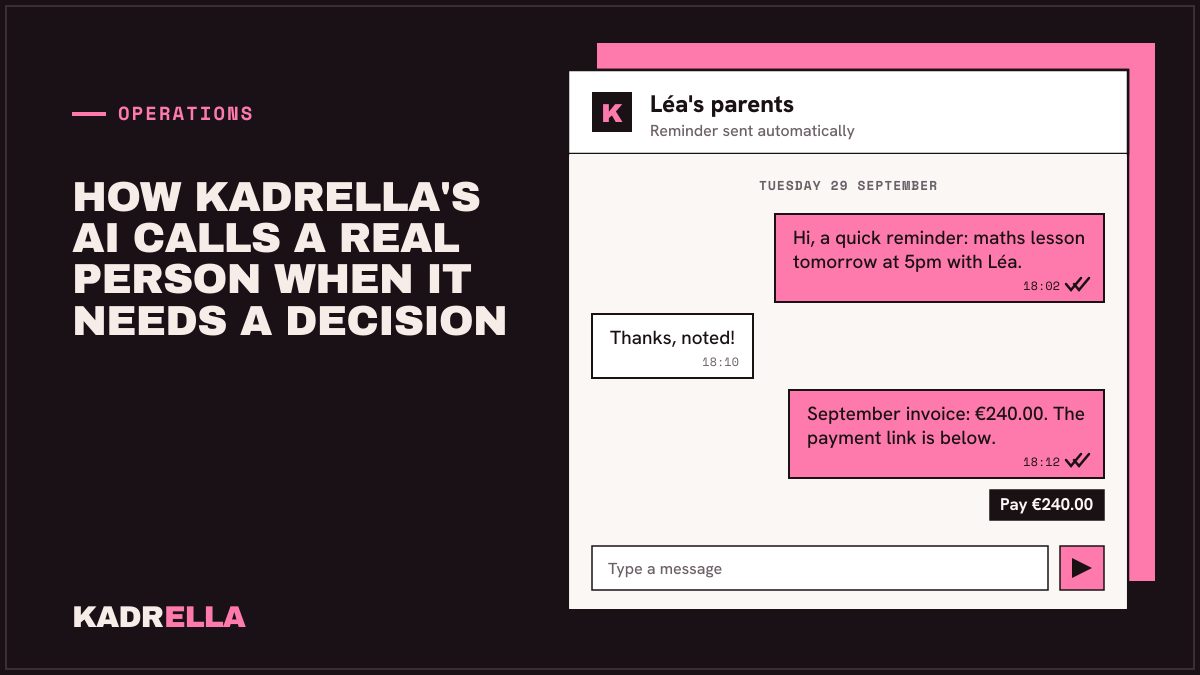 Operations
Kadrella's AI calls you when a decision is needed
Kadrella runs most daily admin on its own. When a decision needs a human, its AI places a real WhatsApp voice call instead of a message nobody reads.
Read the article → Pricing
Raise your tutoring rates 12% without losing students
Going from €25 to €28 an hour is a 12% raise. Give a month’s notice, justify it with market rates, look after loyal families and pick a moment they expect.
Read the article → Taxes
French tax return for tutors: use the 34% allowance
Micro-BNC income, the 34% allowance (€305 minimum), form 2042-C-PRO and the flat-rate option: how tutors report lesson income on the French tax return.
Read the article → Growth
Trial lessons that convert more leads into students
Free or paid, what to do before, during and after: how to run a trial lesson that turns more tutoring leads into regular students, without losing any.
Read the article → Students
Communicating with parents to keep students longer
A student with two lessons a week is worth about €200 a month. Choose a channel, a cadence and useful updates so parents keep their child with you.
Read the article → Operations
Solo tutor or team: Kadrella shows only what you use
A tutor working alone no longer sees the screens built for a multi-teacher business. Kadrella adapts to the choice made at signup, and you can change it.
Read the article → Operations
Currency and timezone, set once in Kadrella
Kadrella detects your currency and timezone at signup and applies them everywhere: invoices, payment images, reports and dashboards. Set it once.
Read the article → Operations
Tutoring contract: clauses that protect your income
A 24-hour cancellation clause, the rate and written payment terms: what a one-page tutoring contract should say, clause by clause, to protect your income.
Read the article → Growth
Keeping tutoring students: €900 a year instead of €200
A student at €25 who stays to the brevet brings €900, against €200 if they leave after eight lessons. When students drop off and what makes them stay.
Read the article → Taxes
VAT and tutoring in France: exempt, with one line
Paid directly by students, most tutors in France are VAT-exempt (art. 261-4-4° CGI). The two conditions, the exact invoice line and the common mistake.
Read the article → Operations
WhatsApp lesson reminders: 2 messages, fewer no-shows
A reminder the evening before and a short one two hours ahead cut no-shows. Wording to copy, the right timing and the consent rules tutors should follow.
Read the article → Growth
Superprof vs Preply: which one takes less per lesson
Preply keeps 18% to 33% of each lesson; Superprof is free for tutors, with 10% only on lessons paid through it. Which platform suits which kind of tutor.
Read the article → Taxes
Income ledger for tutors: stay compliant, no effort
Every micro-entrepreneur tutor in France must keep an income ledger. The columns, the order of entries, the proof to keep and the easiest way to keep it.
Read the article →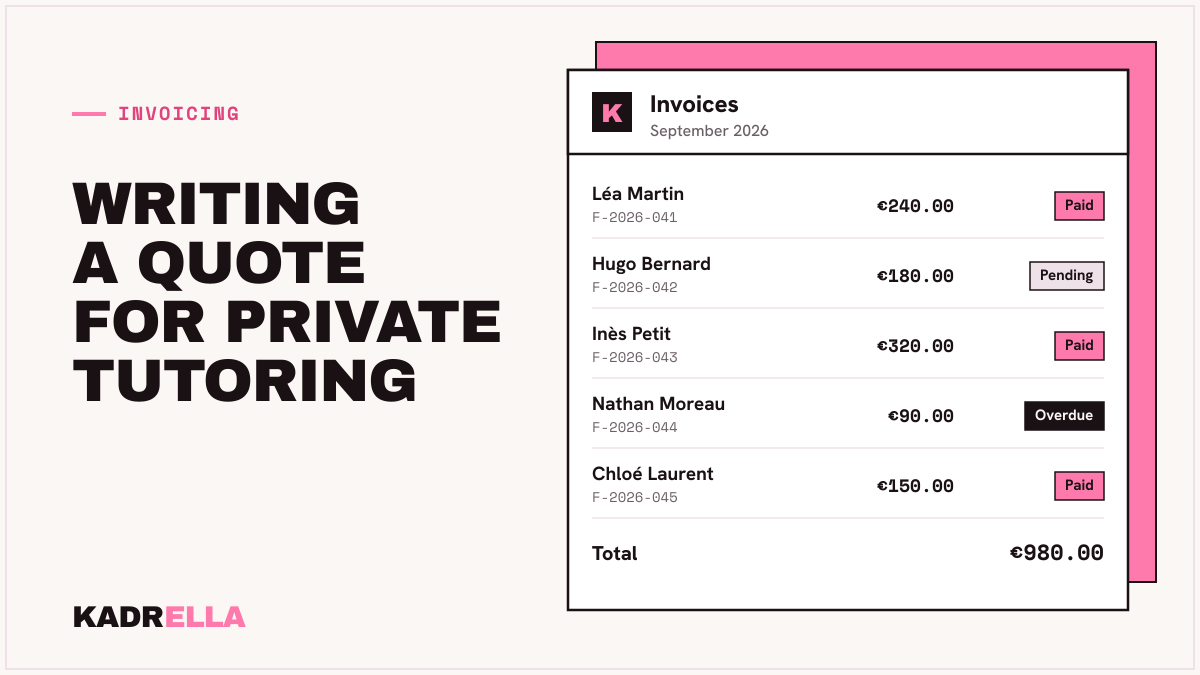 Invoicing
Tutoring quote: when it is mandatory and what to write
When a tutoring quote is mandatory in France, the mentions it must carry, the tax credit line families look for, and a template you send in two minutes.
Read the article → Growth
Reviews and referrals: new students at almost no cost
Reviews and word-of-mouth bring students at almost no cost. When to ask for a review, which referral offer to make and the legal rule to respect in France.
Read the article → Taxes
CESU for tutoring: keep the 50% tax credit
CESU, declarative or prepaid? The 50% tax credit needs lessons at the student’s home. Salaried by the family or self-employed: what changes for you.
Read the article → Operations
Revision course: €760 of revenue in one holiday week
Five days of 2 hours, a €190 package and four students: €760 of revenue in one holiday week. Format, pricing, deposits and how to run each day.
Read the article → Operations
GDPR for tutors: what student data to keep, how long
Which student data to keep, for how long (about 3 years after the last lesson), how to secure it and keep a record: GDPR for private tutors in France.
Read the article → Operations
Online tutoring in France: the tax credit trap
The 50% tax credit does not cover video lessons. Equipment, attention, attendance, billing and data rules: keeping in-person quality when you tutor online.
Read the article → Students
Small-group tutoring: €45 an hour instead of €30
Three students at €15 each earn €45 an hour, against €30 one-on-one. How to form groups, set a fair price and avoid the tax credit trap for group lessons.
Read the article → Taxes
Home-tutoring SAP declaration: 50% back for families
A free NOVA declaration lets your students get back 50% of what they pay for home lessons in France. Which lessons qualify, how to register, what follows.
Read the article → Students
Onboarding a new student: 5 steps that make them stay
Collect details, fix a recurring slot, write down payment terms, run a diagnostic first lesson: 5 steps that turn a new tutoring student into a regular.
Read the article →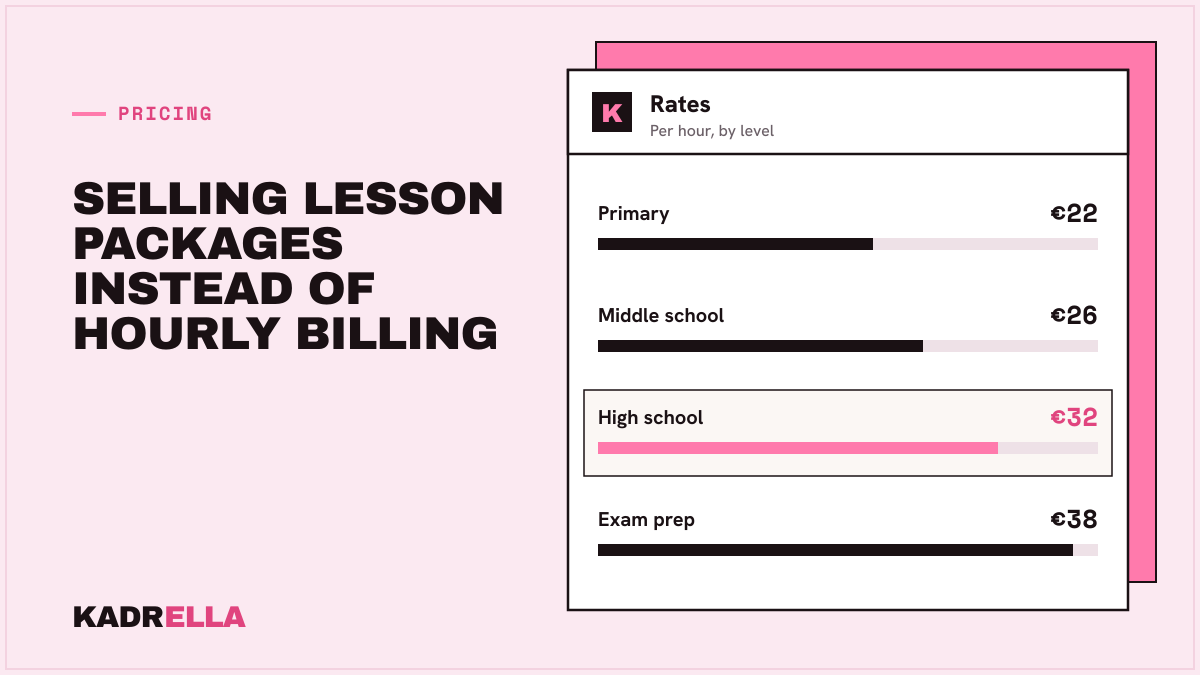 Pricing
Lesson packages: get paid upfront, not by the hour
A 10-hour package paid in advance puts €300 in your account at the first lesson. How to price a pack, track prepaid hours and invoice it in France.
Read the article → Invoicing
Collecting tutoring payments without losing track
Bank transfer, cash, cheque or payment link: the rules for each, invoicing before you collect, and a tracking habit that never lets a payment slip.
Read the article → Operations
New school year: fill your tutoring schedule early
Reconfirm last year’s students in mid-August, fill slots before the rush and announce rate changes in time: the checklist for a full schedule in September.
Read the article → Taxes
Declaring tutoring income to URSSAF: avoid €60 fines
Each missed URSSAF declaration costs €60.10 in 2026. Filing frequency, the 25.6% rate, deadlines and zero returns: report tutoring income without fines.
Read the article → Students
Student progress tracking: reports that keep families
Note what each student has mastered and what to review after every lesson, then send parents a short report: the method that helps families renew.
Read the article → Taxes
Self-employed tutor in France: register the right way
Online registration, SIRET, URSSAF contributions, ACRE, VAT and the tax credit: the steps to teach private lessons in France legally from day one.
Read the article → Growth
Managing a team of tutors: grow past 25 hours a week
A solo tutor tops out around 20 to 25 paid hours a week. When to hire, how your tutors work with you, the usual pay split and how to keep the schedule.
Read the article → Pricing
How much to charge for tutoring without losing money
Rates of €15 to €60 an hour, 25.6% contributions, prep time and the 50% tax credit: how to set a tutoring price in France that leaves you a real income.
Read the article → Taxes
Instant tax-credit advance: families pay only half
With the URSSAF instant advance, families pay only half of your home lessons and you still receive 100%. Who qualifies, how to enroll and the caps.
Read the article →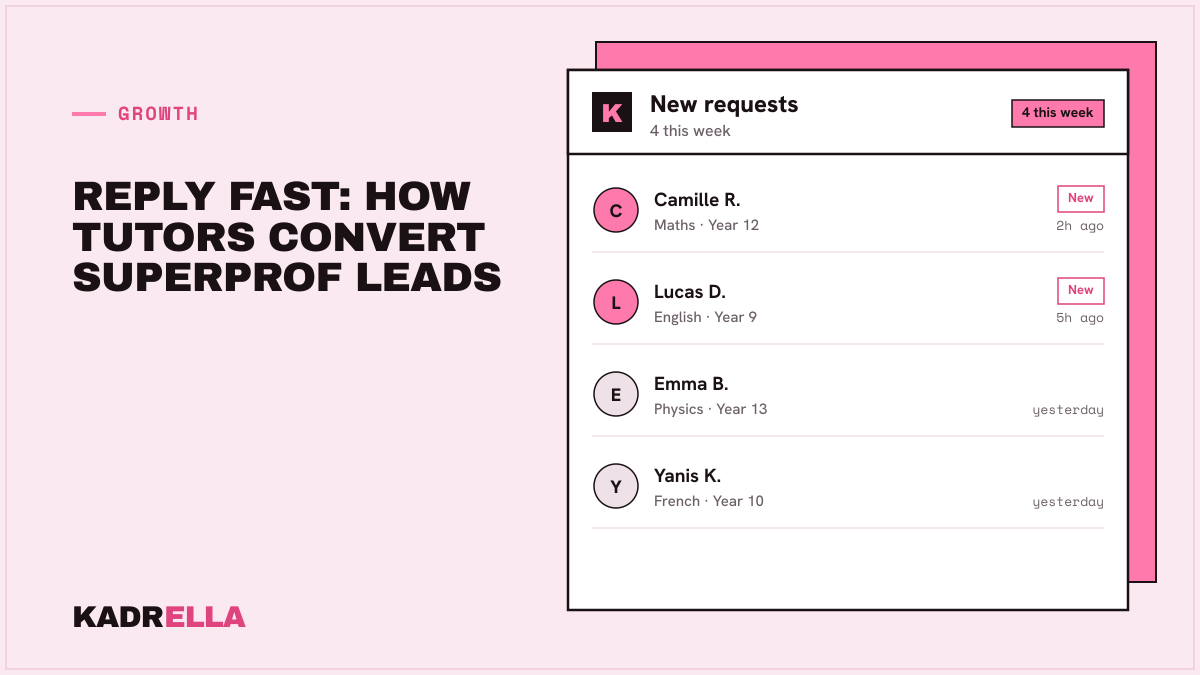 Growth
Superprof leads: the fast reply that wins the student
A parent writes to several tutors the same evening. The fast reply, clear rate and two time slots that turn a Superprof lead into a weekly student.
Read the article → Operations
Tutoring schedule: win back 36 lost hours a year
One forgotten slot a week costs about 36 hours over a school year. Set a recurring base, move lessons without duplicates and tie your schedule to billing.
Read the article → Invoicing
 private lessons in France: avoid the fine
A note from €25, mandatory mentions, the VAT franchise line, numbering and 10-year storage: the rules to invoice private lessons in France without a fine.
Read the article → Students
Tutoring cancellation policy: a 24-hour rule that pays
At 6% no-shows, a tutor with 25 lessons a week loses close to €1,600 a year. A 24-hour policy and a WhatsApp reminder the evening before stop most of them.
Read the article → Operations
Tutoring without spreadsheets: win back a day a term
A spreadsheet handles five students, then eats more than a full working day per term. The signs it is time to switch and how to move over in a week.
Read the article → Invoicing
Late tutoring payments: 3 reminders that get you paid
Three WhatsApp reminders, at 3, 10 and 20 days past due, get tutoring families to pay without awkward calls. With example messages and rules to set first.
Read the article → Taxes
50% tax credit for tutoring in France: €40 costs €20
A €40 home lesson costs the family €20 after the 50% tax credit. How tutors in France register as a service provider and issue the annual certificate.
Read the article →
Spend your Sundays teaching, not chasing payments.
Free to start, set up in minutes. No card.